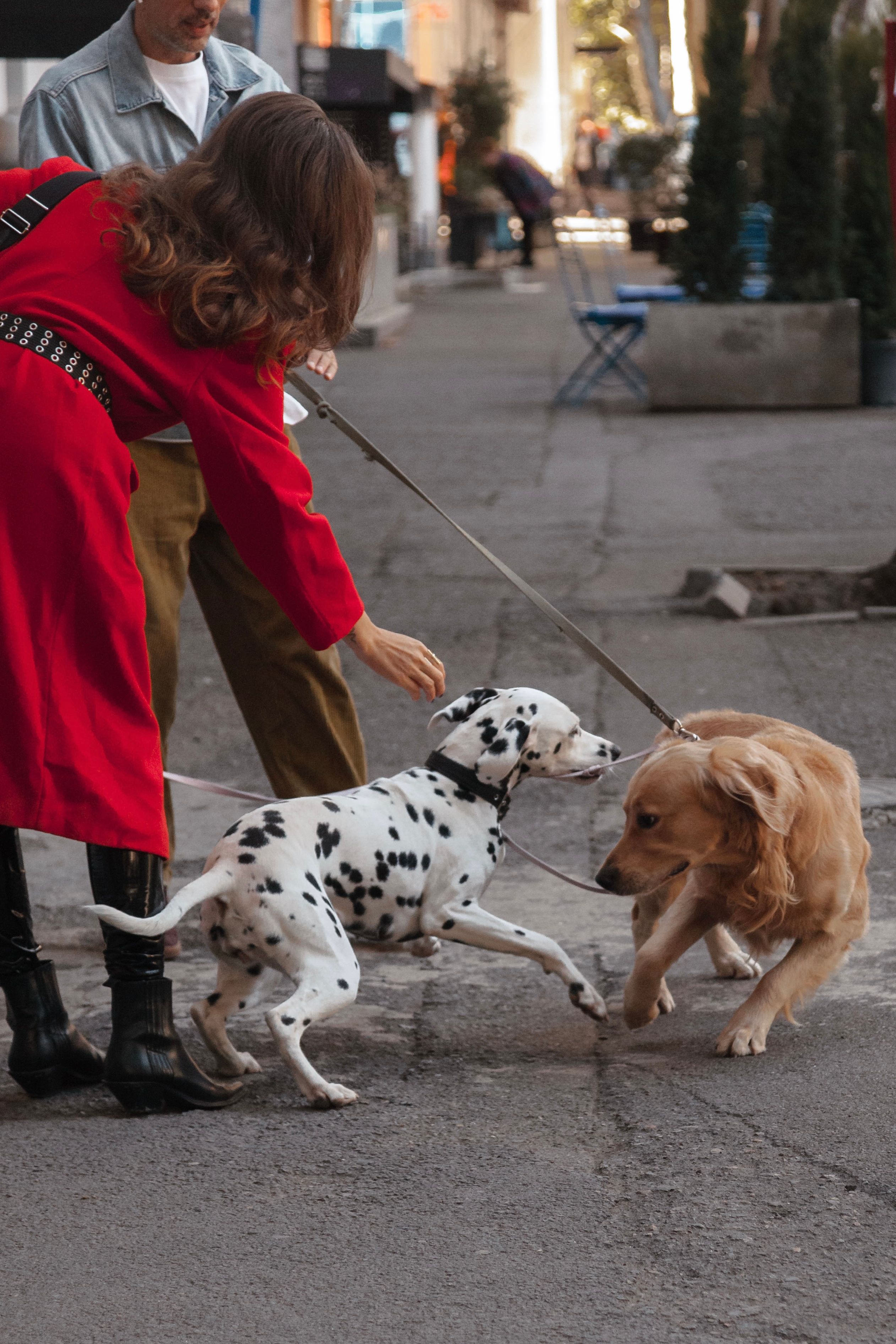
Leash Reactivity: Why Your Dog Lunges and Barks on Walks — and How to Help
Walks are meant to be enjoyable for both you and your dog, but that can quickly change if every passing dog triggers barking, lunging, or leash pulling. Leash reactivity is a common behavioral issue that many owners face, and understanding why it happens is the first step toward helping your dog feel calmer and more confident.
Leash reactivity is common. I see it a lot in practice, and I also see dogs get better from it more often than people expect. I myself have 16 dogs, and most of them have a history of leash reactivity. While most of them outgrew it, most of them still get reactive on the leash. As a small animal practitioner, I see owners come in because they feel frustrated that they struggle when they walk their dogs or have already stopped taking their dog on walks, which is understandable, honestly, because it can become too stressful. It takes patience, yes, and some days will be ugly, but it is not a hopeless problem by any stretch.
What Is Leash Reactivity?
Leash reactivity means your dog is having a much bigger response than the situation calls for, usually to another dog, a jogger, a skateboard, a garbage truck, or something else that catches their attention in the wrong way.
People often associate this with aggression, which creates a lot of unnecessary panic. A dog that barks and lunges on leash is often overwhelmed or frustrated. That is a different situation from a dog that truly wants to bite someone, and the difference matters because it shapes how you respond.
A lot of leash-reactive dogs are perfectly fine off leash, at home, or in other calm settings. I hear that all the time, especially with dogs that seem almost normal until the leash goes on. Once you think about what the leash does, it makes sense. It takes away a dog's ability to create space, curve away, or approach on their own terms. Some dogs handle that fine, but others do not.
Why Dogs Become Reactive on Leash
Most of the time, you are looking at fear, frustration, or some combination of the two. A dog that wants distance and cannot get it may escalate to make that distance happen. A dog that is very social and gets blocked from greeting can get just as worked up, just for a different reason. Limited exposure early in life, or a single bad experience, can also leave a mark that lasts. I have seen plenty of dogs who were doing okay until one bad encounter changed the whole picture, and then suddenly every walk becomes an argument.
Pain is worth ruling out, too. If the reactivity showed up suddenly or has gotten noticeably worse lately, I would want a vet visit before anyone settles on "just behavioral" as the answer. A dog that is in pain has less patience for stress, and things that used to roll off their back can suddenly become a big deal. Arthritis is a common one, though it is far from the only possibility. I have also seen dogs referred for what seemed like a behavior problem, only to discover an orthopedic issue or another painful condition underneath. Once the pain was addressed, training became much more productive.
Underneath all of this is a stress response. Your dog's brain has already decided the trigger is not safe, and the body shifts into fight-or-flight. Once that happens, your dog is not really in a good place to listen, think, or make a sensible choice. Yelling in the middle of a meltdown usually goes nowhere because there is not much learning happening in a brain that is already flooded with stress.
What Should You Do During a Walk?
When a trigger shows up on a walk, the goal is not to fix the behavior right then. The goal is to get through it safely and as calmly as you can.
Create distance as soon as you can, whether that means crossing the street, turning around, or stopping somewhere with less going on, away from crowds and other animals. Keep your own voice and body loose. If your dog glances at you or looks away from the trigger on their own, reward it. And if they are already past the point where they can think clearly, do not try to push them through it. That rarely helps.
I do not recommend punishing the reaction itself. A leash pop, a sharp correction, or a prong or shock collar might stop the behavior for a few seconds, but none of that touches the fear or frustration underneath. In plenty of dogs, it makes things worse. There is also a quieter problem with punishment: you can shut down a growl or a bark without changing the reason it happened, which removes a warning sign you actually want to keep.
A Step-by-Step Training Plan
The most reliable long-term approach is gradual desensitization and counter-conditioning. In simple terms, that means exposing your dog to a trigger at a level they can comfortably handle while pairing it with something they genuinely enjoy. That means your dog notices the trigger from far enough away to stay calm, and you pair that moment with something wonderful until the trigger starts predicting good things instead of trouble. This takes time. Weeks or months, usually, not days.
Before formal training starts, it helps to make walks easier so your dog is not having big blowups over and over. Walk at quieter times, choose routes with more space, or use the yard for bathroom breaks when you can. I know people sometimes worry that they are avoiding the problem, but in the early stages that simply gives you a better shot at real training.
One of the first things I look for is how close a dog can get before they stop thinking and start reacting. That is their working distance. For some dogs, that is thirty feet. For others, especially with fast-moving triggers like bikes, it is much farther. The exact number is less important than whether your dog can still eat, think, and respond to you. If they cannot, you are simply too close.
It also helps to know your dog's early stress signals so you can step in before things escalate. Lip licking, yawning, a stiff body, ears pinned back, and weight shifting away from the trigger are all useful clues. Some dogs give you very subtle warning signs, and if you miss those the first time around, the whole walk can go sideways before you know it.
Practice a couple of simple cues somewhere calm and boring before you try them near a real trigger. A check-in, something like "look at me," and an easy direction-change cue like "let's go" give you something concrete to use on a walk instead of just hoping for the best. I like having owners practice these in the kitchen, in the hallway, in the driveway. Somewhere dull. Somewhere the dog can actually learn.
Once those pieces are in place, the real work looks like this: at your dog's working distance, let them notice the trigger, then mark the moment and hand over something genuinely excellent, chicken or cheese rather than regular kibble. Keep it coming while the trigger is around and your dog stays under threshold. You are building a new association: trigger equals food, not trigger equals trouble.
If your dog stops taking treats or shows stress signs, that is your cue to add distance. If a reaction happens anyway, do not make a big scene. Just move farther away, let things settle, and try again next time at an easier distance. I have a lot of respect for owners who can do that without getting flustered, because honestly, that is where the work starts to feel repetitive and the walk can turn into a bit of a slog.
From there, progress should be gradual. Once your dog is calm and engaged across several sessions at a given distance, shrink that distance a little. If the reactivity comes back, you moved too fast. That is normal. It does not mean the plan is not working. It just means the next step needs to be smaller.
A simple log helps too. Write down the trigger, the distance, and how your dog handled it. A good walk on Tuesday and a rough one on Thursday do not mean much by themselves. The pattern over several weeks is what matters. If you are stuck for weeks despite steady work, or things are getting worse, that is the point where I would bring in a professional.
When to Seek Professional Help
Reach out to a professional if your dog has ever bitten a person or another animal, if you do not feel physically safe handling them, if several consistent weeks of subthreshold work have not changed much, or if things seem to be getting worse. A board-certified veterinary behaviorist, a certified applied animal behaviorist, or a trainer who genuinely works force-free are all good places to start.
If the reactivity showed up suddenly or appeared later in life without an obvious cause, start with your vet rather than a trainer. Pain hides in plain sight more often than people expect.
Final Thoughts
Leash reactivity is exhausting, but it is also one of the behavior problems that often improve with time and the right approach. The progress is usually uneven. Some weeks are better than others, sometimes within the same week. That does not mean you are failing your dog. Also, remember that your dogs react to the way you react. If you show tension and fear that something might happen during the walk then your dog will panic and will stay reactive.
Stay calm, keep the work below threshold, and take smaller steps than feel necessary. Do that consistently, and walks can start to feel normal again.
This article is for informational purposes only and is not intended to be a substitute for veterinary medical advice. Please consult your veterinarian or a certified behavior professional for guidance specific to your dog.
References
American Society for the Prevention of Cruelty to Animals. (n.d.). Managing and training leash-reactive dogs. ASPCApro.
American Society for the Prevention of Cruelty to Animals. (n.d.). Position statement on training aids and methods.
American Veterinary Society of Animal Behavior. (2021). Humane dog training position statement.
American Veterinary Society of Animal Behavior. (2021). Three ways that management can help you with your pet.
Cornell University College of Veterinary Medicine, Riney Canine Health Center. (n.d.). Managing reactive behavior.
University of California, Davis, School of Veterinary Medicine. (2019, April 9). Loose leash walking.