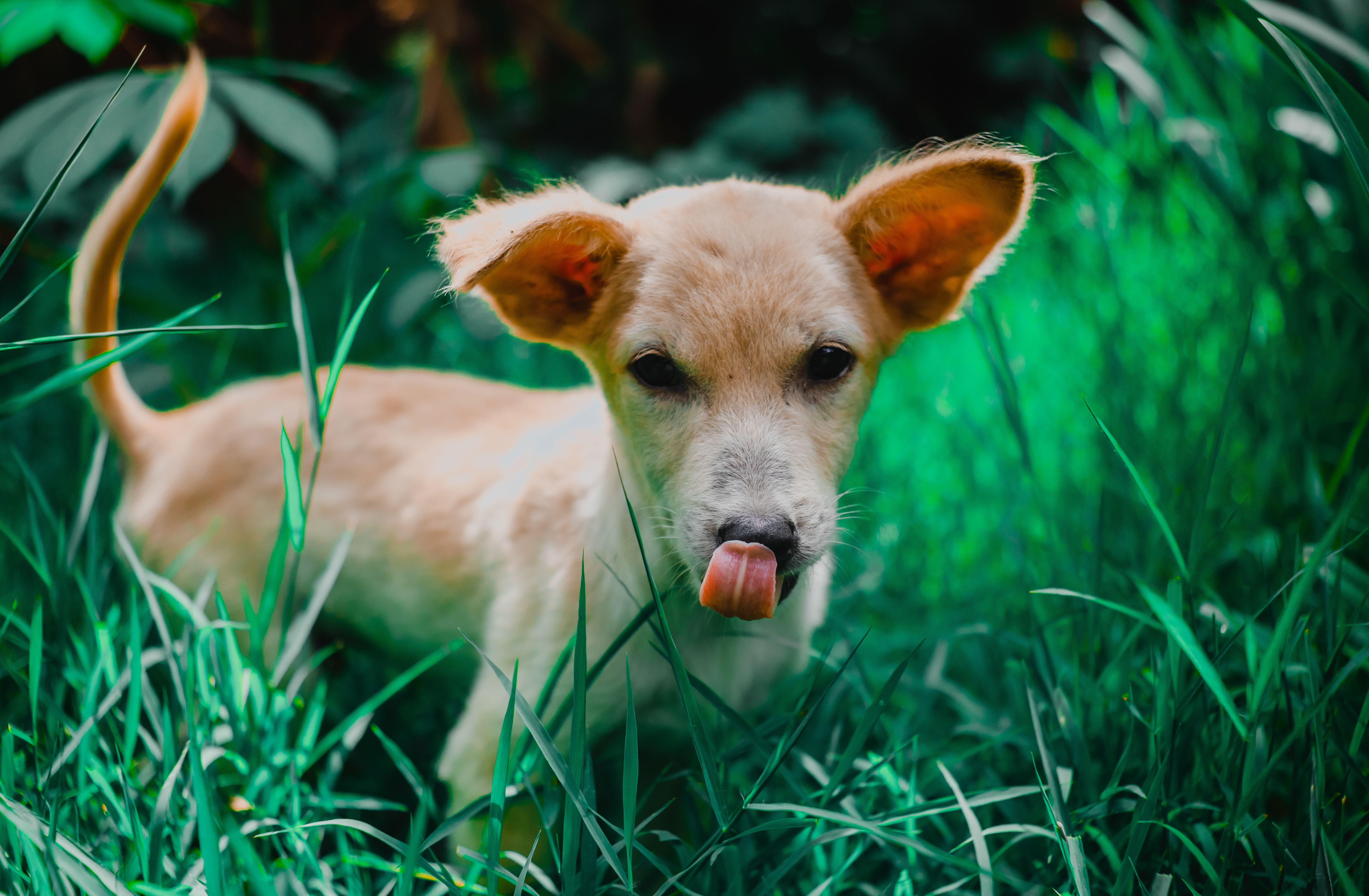
Why Does My Dog Eat Grass? A Vet's Guide to Your Dog's Lawn Snacking Habit
If your dog treats the backyard like a salad bar, you are not alone, and you are probably not looking at a problem. Grass eating is one of the questions I get asked most often in practice, usually from an owner who just watched their dog graze through half the lawn and then, sometimes, throw it back up on the kitchen floor five minutes later. The panic is understandable. The internet is full of confident answers about what this means, and most of them contradict each other.
I have 16 dogs of my own, and at any given time, most of them are out there eating grass like it's their job. A few of them do it daily. A couple have never touched the stuff. None of it has ever amounted to anything serious. So before we get into the details, take a breath. This is one of the most common behaviors I see in perfectly healthy dogs, and honestly, one of the most over-explained topics in all of veterinary medicine. Everyone has a theory. Not everyone has the evidence to back it up.
Let's go through what we actually know, what's still a guess, and when this quirky little habit is worth a call to your vet.
Is This Normal?
Yes, for the most part. Studies looking at plant eating in dogs have found that a large majority, somewhere around 70 to 80 percent depending on the study, eat grass or other plants on a regular basis. This is not limited to dogs with upset stomachs or dogs on certain diets. Puppies do it. Senior dogs do it. Dogs on premium diets do it just as often as dogs on budget kibble.
What surprises a lot of owners is that most dogs who eat grass show no signs of illness before or after. They are not hunched over, they are not refusing food, they are just wandering the yard treating the lawn like a snack bar. That alone tells us this behavior is not primarily driven by sickness, even though sickness can be part of the picture sometimes.
Why Do They Actually Do It?
This is where I have to be honest with you instead of confident. Nobody has one tidy answer, and any article that hands you a single clean explanation is oversimplifying. Here is what the leading theories actually look like, and how well each one holds up.
Ancestral, instinctive behavior: Wolves, coyotes, and other wild canids have long been observed eating plant matter, including the stomach contents of herbivore prey they take down. Some researchers think modern dogs carry over a bit of that instinct, treating grass as a low stakes extension of natural foraging behavior that never fully disappeared through domestication. It is a reasonable theory, and it fits with how casual most grass eating looks, more grazing than gorging. But it is hard to prove directly, since we cannot exactly ask a dog why it is doing something. Plausible, not proven.
Boredom or attention seeking: This one has decent behavioral support behind it. Dogs left alone in a yard for long stretches, or dogs who are not getting much mental stimulation day to day, often develop repetitive oral behaviors, and grass chewing can be one of them, right alongside things like excessive licking or chewing on furniture. If your dog eats grass mostly when nothing else is going on, or ramps it up noticeably when understimulated, boredom is a strong candidate. I see this a lot with dogs whose owners work long hours and come home to a very thorough lawn mowing job already done for them.
Fiber or nutrient seeking: There is a long standing idea that dogs eat grass because they are missing something in their diet, and it is probably the most repeated explanation online. The science here is actually weaker than people assume. Most grass eaters are on complete and balanced commercial diets with no deficiencies showing up on bloodwork. That said, grass is a source of insoluble fiber, and some dogs may be responding to a mild urge for roughage, especially if their stool has been a little loose or irregular lately. I would call this a minor factor for most dogs, not the driving one.
Taste and texture preference: Sometimes the simplest answer is the right one. Dogs explore the world with their mouths, and some individual dogs just seem to like the taste or texture of fresh grass, especially new spring growth that is softer and sweeter than older blades. This is not a medical explanation at all. It is closer to a dog having a favorite snack, the same way some dogs go wild for carrots and others will not touch them.
Self induced vomiting: This is the theory almost every owner already believes walking in the door, and it deserves its own section, because the evidence does not actually support it the way people think.
Here is the belief nearly every dog owner arrives with: my dog eats grass because he feels sick, and the grass makes him throw up. It feels logical. It is also not well supported by research.
Multiple behavioral studies, including observational work out of universities studying companion dog behavior, have found that only a small minority of grass eating episodes, generally under 25 percent, are followed by vomiting. Most of the time, a dog eats grass and nothing happens afterward. No nausea beforehand, no vomiting after.
There is also a cause and effect problem baked into the popular theory. Vomiting after grass eating is often a mechanical response to how the grass was eaten, not evidence the dog was nauseated first. Dogs frequently gulp grass down fast without much chewing, and long fibrous blades can irritate the stomach lining or esophagus purely from the texture. That irritation can trigger vomiting on its own, whether or not the dog felt unwell beforehand. So the sequence owners assume, felt sick, ate grass, threw up to feel better, often is not what actually happened. More often it is simply, ate something coarse too fast, stomach reacted to it.
This matters because it changes what vomiting after grass eating should mean to you. Occasional vomiting tied to fast, poorly chewed grass eating is usually mechanical, not medical.
When Is It Harmless, and When Should You Call Your Vet?
Most of the time this is a quirk, not a symptom. But there is a real decision point, and here is how I walk owners through it.
Likely harmless if grass eating happens occasionally rather than daily or multiple times a day, your dog is otherwise eating, drinking, and behaving normally, any vomiting is a single episode followed by a return to normal, and there is no weight loss, lethargy, or change in appetite.
Worth a vet visit if grass eating becomes frequent or almost compulsive, vomiting happens repeatedly rather than once in a while, you notice weight loss, appetite changes, lethargy, or diarrhea alongside it, your dog seems anxious or distressed before eating grass rather than casual about it, or the behavior started suddenly in an older dog with no prior history of it.
That last one matters more than people realize. A new behavior showing up out of nowhere in a dog who has never done it before is a different conversation than a lifelong grass nibbler continuing an old habit. Sudden changes deserve a workup, since they can occasionally point to gastrointestinal disease, pancreatitis, or in rare cases a partial obstruction. I am not saying this to alarm you. I am saying it so you have a clear line between quirky and concerning.
The Risks Nobody Talks About
This part has nothing to do with why dogs eat grass and everything to do with what is actually on the grass, and it is the part I wish came up more in casual conversation.
Lawn chemicals are the biggest practical risk here, full stop. Pesticides, herbicides, and fertilizers can remain toxic on the lawn surface for hours to days after application, even when the grass looks completely dry and perfectly fine to the naked eye. If you treat your own lawn, follow the product's stated reentry interval before letting your dog back on it, and store any leftover product somewhere your dog cannot get into. If you do not know whether a park, golf course, or a neighbor's yard has been treated recently, assume caution and steer clear.
Parasites are worth knowing about too, even though most owners have never thought about grass this way. Slugs and snails can carry lungworm larvae, and dogs who graze can accidentally ingest them right along with the grass. This is a bigger concern in some regions and climates than others, generally where conditions stay damp, so it is worth asking your vet whether it is something to actively watch for where you live.
Foreign body and obstruction risk is uncommon but real, and it is the one owners are least likely to have ever considered. Long, tough, or fibrous grass, especially mature grass gone to seed, does not always break down well in the digestive tract. In rare cases, large amounts of poorly chewed grass can contribute to a gastrointestinal obstruction, particularly in small dogs. This is part of why frequent, aggressive grass eating deserves attention even without any vomiting attached to it.
What You Can Actually Do
You do not need to eliminate grass eating entirely for most dogs. A few practical steps go a long way instead.
Skip the chemicals where your dog roams, or at minimum respect the reentry window on any treated lawn to the letter. Pet safe lawn care products exist now and are worth a look if you have a dog who grazes often.
Address boredom directly. If your dog eats grass mostly when unsupervised or understimulated, adding a puzzle feeder, a chew alternative, or simply more structured exercise and mental engagement in the day often reduces the behavior on its own.
Look at fiber in the diet if grass eating is frequent and your dog's stool has been inconsistent lately. A conversation with your vet about a specific diet adjustment is going to get you further than guessing at over-the-counter supplements on your own.
Redirect rather than punish. If grass eating happens in a specific risky spot, like a treated area or somewhere with known parasite exposure, redirect your dog with a toy or a change of route instead of scolding them for it. For occasional, low risk grazing in a safe yard, redirection usually is not necessary at all.
Final Thoughts
Grass eating is common, usually harmless, and rarely the dramatic warning sign owners fear it is. The honest answer is that we do not have one clean explanation for why dogs do it, and any given dog may be doing it for a mix of reasons at once. What actually matters is the pattern. Occasional and casual is normal. Frequent and compulsive deserves a vet visit. And what is on the grass itself is often a bigger concern than the behavior ever was.
Know your dog's baseline, keep an eye on the details above, and you will know the difference between a lawn snack and a reason to make a call.
This article is for informational purposes only and is not intended to be a substitute for veterinary medical advice. Please consult your veterinarian for guidance specific to your dog.
References
Merck Veterinary Manual. (n.d.). Behavior problems of dogs.
Sueda, K. L. C., Hart, B. L., & Cliff, K. D. (2008). Characterisation of plant eating in dogs. Applied Animal Behaviour Science, 111(1-2), 120-132.
Hart, B. L. (2008, June). Why do dogs and cats eat grass? Veterinary Medicine, 103, 648-649.
Cornell University College of Veterinary Medicine, Riney Canine Health Center. (n.d.). Gastrointestinal foreign body obstruction in dogs.
American Society for the Prevention of Cruelty to Animals. (n.d.). Tips for a pet-safe yard and garden.
VCA Animal Hospitals. (n.d.). Lungworm infections in dogs.